Posts

2 Categories of Clutterers

Image
  One of my favorite authors on the topic of clutter and living clutter-less is Sandra Felton, author of Messie No More and The Messie's Manual , now updated to The New Messie's Manual .  Sandra, herself a "reformed messie" [sic] has some useful surveys helping people get clarity about the base reasons for their struggles with clutter.   via GIPHY Sandra has broken down cluttering behaviors into essentially 3 categories: "Saving" clutterers, "Messie" clutterers, and "Time Wasting" clutterers.  In summarizing Sandra's categories, I've consolidated them into only two: "Saving" and "Messie" clutterers.   I'm also including some anti-clutterers thoughts  (AC T ) , to help you work toward a new mindset for managing possessions. As was outlined in this post , one part of the problem with "M.E.S.S." is often emotional , and Sandra's breakdown covers a large number of the emotional factors. They will...
20+ Decluttered Items Not To Be Trashed--and Alternatives...

  Decluttering your spaces is a whale of a decision-making "fiesta".  As an organizer, I find it a pleasant kind of challenge, but that's beside the point.  The big deal about all that decision making, however, is that you're left with a hefty pile of things to be dealt with in one of several ways: keep them,  give them away,  sell them, or   trash them.   And trashing them can often be quite a puzzle and cause some real angst.  Fortunately, there are some great options for many of these items, and I'm giving a big shout out to AARP for a recent article they published about this topic (they publish some really great material on downsizing , pertinent to the decluttering process whether you're moving households or not!). The November 2022 AARP bulletin included "How Do I Get Rid of This? A handy guide for disposing of those items that shouldn't go in the trash".   Sadly, it is not available on their Bulletin website, but it is a ve...

Project BEFORE / AFTER photos

Image
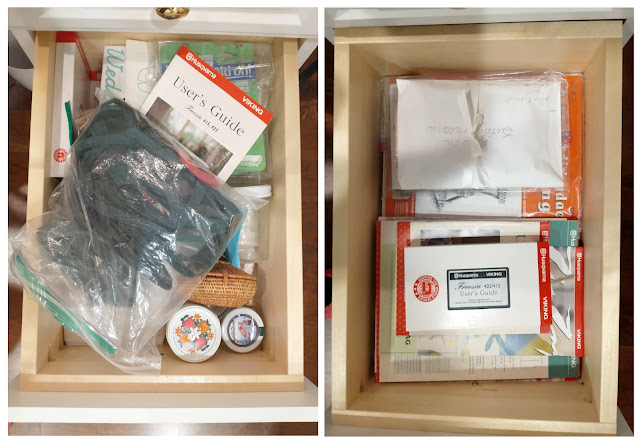
 Project "Cute Rules" -  These before/after images are from decluttering a sewing/craft room and an office in a home that is sneakily cluttered. This home is beautifully kept, tastefully decorated, and delightfully welcoming because the client is a master of creating memorable moments with friends and guests.  The "sneaky" part is that the cluttered state is behind closed doors in cabinets, closets and drawers.  These drawers represent about 4 hours of work (there were some other cabinets that also got a makeover during the same session), and the client made a considerable sacrifice in letting go of things--difficult decisions. I was/am terrifically proud of her! She stated that she probably avoided using the sewing room a lot because it was just overwhelming trying to find the necessary tools for projects.  Getting it in order makes it a real joy to work on projects now! The contents of this drawer were a "repeat collection" of things that had already b...

6-Step EECDID Decluttering Process

Image
 What in the heck does EECDID stand for?!?!  Glad you asked! E vacuate  E liminate C onsolidate D esignate I n a Crate D efend the State  EECDID (pronounced "EEK did") is my own goofy acronym for the decluttering and organizing process. I'm posting it here for you just in case you: Don't have access to a professional organizer Haven't yet read a bunch of books on the topic, and want to try to go it alone ;   Have read some books about how to declutter but haven't yet put any of it into practice;  Bought the book but haven't gotten around to reading it, and it's sitting on a cluttered shelf... Are just curious Let's start with planning for a decluttering session.  When someone works with me, I request a minimum  2-hour session, preferably 4.  But my very presence with the client is what may make it possible for her to make it through that period.  When tackling it on your own, a 15-minute session, or maybe up to 1 hour, may be the maxim...

7 Top Questions for Controlling Paper Clutter

Image
  In another post, 3 Best Declutter Questions for "The Collection" , I covered 3 essential questions I ask  clients while helping them decide what to discard.  There are also some basic questions for paper clutter , and if put into practice they build some real "mental muscle" when confronting stacks of paper.  I once watched a particular client in just one session go from total indecision about every piece of paper she touched to literally flipping paper into the recycle/trash piles at a glance as if she were dealing cards!  😁 Question #1 What's the worst thing that can happen to me if it didn't exist?   (If nothing, or something really minor, toss.) Question #2 Is it replaceable (on the web, by phone call to original source, logging in to your account somewhere, etc)? This includes bills and monthly statements... Almost any so called important piece of paper that comes into our homes and requires a payment or has to do with financial, medical or tax-re...

Pet Snakes and Paper Clutter

Image
    While wandering through my head one day, thinking about paper clutter, the following occurred to me after working with a particular home organizing client. A couple of my clients (including the one in mind) have kept "pet" snakes among their "collections". Unlike the rest of the accumulations, the snake isn’t usually considered part of the excess, though I wonder about that…  Pet just doesn’t mesh well in my mind with snake . Pet evokes images of cuddly, furry, warm creatures, alternately comforting and/or amusing us as we interact with them through daily life. We speak of loving our pets, as if they were people. Not so the snakes. I haven’t heard that kind of sentimental talk about them yet. Announcing that you keep one elicits a broad range of responses, generally negative; in fact, “aversion” seems mild for the most common reaction. As for usefulness or entertainment value,...